This is the biggest equity-raising exercise by an Indian corporate within a financial year. The fundraising - led by Citibank, Goldman, Kotak and Axis Capital as bankers - will see participation by foreign and domestic institutional investors.
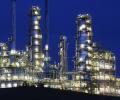
BPCL's impending privatisation and RIL's stake sale to Saudi Aramco raise questions about the future of the West Coast Refinery, once touted as the world's largest.

Railways to hive off all production units and workshops into new govt-owned company; may invite bids from private players to run passenger trains in next 15 days, with ownership vesting with the government.

Richest 10 account for 41% of promoter wealth, up from 33% in December 2018, says Krishna Kant.
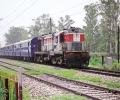
The new board will have a leaner structure on functional lines headed by the chairman and four members - covering infrastructure, operations and business development, rolling stock, and finance.

The Sensex is on course to ending calendar year (CY) 2019 at a price-earnings (P/E) multiple of 29x, the highest in 25 years. Current valuations are, however, lower than those seen in the early 1990s. The Sensex has risen close to 14 per cent in the last 12 months, while the index underlying EPS dropped 6.7 per cent during the period.
Indian Railways is in talks with Reliance Jio Infocomm to allow the Mukesh Ambani-led telecom major's use of its towers. The aim is seamless mobile and internet connectivity for passengers along the 67,368-km of tracks. The Railway Board has entrusted its RailTel Corporation arm to work on the modalities with Jio. The Jio tie-up is expected to bring down its telecom bill by at least 35 per cent from this financial year.

Recently listed companies scored 54, compared to 58 for the BSE100 firms and 61 for entities in the Sensex pack. The report noted that issues remain in IPO companies in which there seems to be a need to institutionalise governance practices.

Ghost beneficiaries aren't the only kind of issue companies face during a period of unprecedented CSR spending, touching nearly Rs 12,000 crore in 2018-19. Frauds related to procurement, construction, and end-use of funds have had companies engaging forensic auditors to keep tabs on how money is spent, revealed conversations with those involved in such investigations. Firms are also increasingly strengthening their own capabilities to better implement their programmes.

The biggest spend (Rs 4,406 crore) was for Schedule VII (II), which involves "promoting education, including special education and employment enhancing vocation skills, especially among children, women, elderly and the differently abled and livelihood enhancement projects". The FY19 spend was 17.2 per cent higher than Rs 1,0128.3 crore spent during the previous year.

Indian funds did better than Asian ones in only four of the 10 months -- till October. Despite much market optimism, presumably around policy interventions and guided by buoyant flows, India's macro backdrop may be turning for the worse.
The company has a valuation of Rs 2.22 trillion, up from Rs 1.33 trillion a year ago.
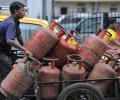
Only 48.3 per cent of the rural households used LPG, while the figures were much higher in urban areas at 86.6 per cent, according to a NSO report.

Lower cost and easier termination may well be among the reasons that companies seek to have employees on contract. The share of employees on contract has increased to 57.3 per cent of the total workforce this year as compared to 53.7 per cent in the previous year.

The lack of a strong diversity policy on the part of companies, a limited pool of women candidates as well as socio-cultural factors contribute to their low numbers.

Collapse of the mobile operator could translate into total loss of nearly Rs 44,000 crore for the AV Birla group.

To prevent rise in air pollution levels, oil marketing companies and thermal power units were planning to procure stubble from farmers to make bioethanol and promote the central government's 'Agricultural Mechanization' for crop residue management. But both have seen minimal success.

While Rakesh Jhunjhunwala is up 14.9% during the year to Rs 12,381 cr, Ashish Dhawan is up 68.4% to Rs 810 cr, Ashish Kacholia is down 23.4% to Rs 515 cr, Rajiv and Dolly Khanna are down 74.6% to Rs 116 cr and Vijay Kedia is down 6.2% to Rs 294 cr.

The biggest spender was Tata Motors, with Rs 4,224.6 crore assigned under the R&D head.
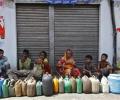
A major reason for the decline in the consumption of kerosene was an increase in the number of LPG consumers in rural India after the government launched the Pradhan Mantri Ujjwala Yojana. in 2016.
 © 2026 Rediff.com - Investor Information - Advertise with us - Disclaimer - Privacy Policy - Sitemap - Feedback - About us - Terms of use - Grievances